
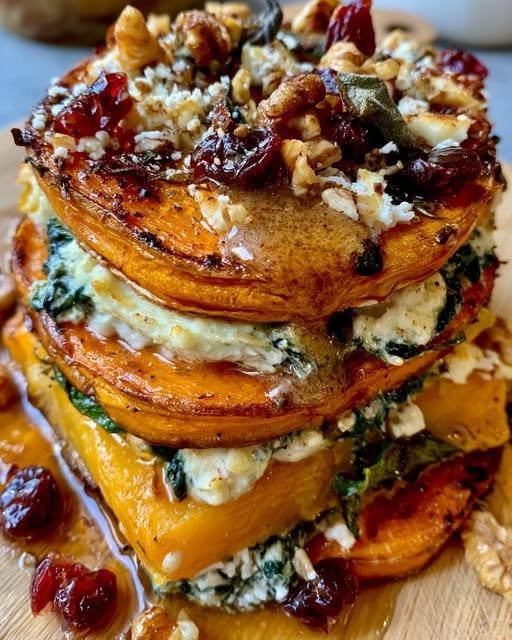
A beautiful, cozy fall-inspired dish featuring tender layers of sweet potato and butternut squash, creamy spinach and feta, crunchy toasted walnuts, fragrant sage brown butter, and sweet-tart cranberries. This elegant vegetarian lasagna stack is perfect for Thanksgiving, holiday dinners, or a comforting seasonal meal.
Prep Time: 25 minutes
Cook Time: 50–60 minutes
Total Time: 1 hour 20 minutes
Servings: 4
Course: Main Course or Side Dish
Cuisine: Seasonal Mediterranean-inspired
Ingredients
For the Vegetable Layers
- 2 medium sweet potatoes, peeled and sliced into thin rounds
- 1 small butternut squash, peeled, seeded, and sliced into thin rounds
- 2 tablespoons olive oil
- 1 teaspoon garlic powder
- ½ teaspoon dried thyme
- ½ teaspoon salt
- ¼ teaspoon black pepper
For the Spinach and Feta Filling - 3 cups fresh baby spinach
- 1 cup crumbled feta cheese
- ½ cup ricotta cheese
- 2 cloves garlic, minced
- 1 tablespoon olive oil
- ¼ teaspoon ground nutmeg
- Salt and black pepper, to taste
For the Walnut and Cranberry Layer - ¾ cup walnuts, roughly chopped
- ½ cup dried cranberries
- 1 tablespoon maple syrup or honey (optional)
- 1 teaspoon fresh thyme leaves (optional)
For the Sage Brown Butter - 4 tablespoons unsalted butter
- 8–10 fresh sage leaves
- 1 small garlic clove, finely minced (optional)
- Pinch of salt
- 1 teaspoon lemon juice (optional)
For the Top - ¼ cup grated Parmesan cheese (optional)
- 2 tablespoons crumbled feta
- A few extra dried cranberries
- Fresh sage leaves for garnish
Instructions
Step 1: Prepare the Oven and Vegetables
Preheat the oven to 400°F (200°C). Lightly grease a baking dish with olive oil.
Peel the sweet potatoes and butternut squash. Slice them into thin, even rounds, approximately ⅛–¼ inch thick, so they cook evenly and form neat layers.
Place the slices in a large bowl. Add olive oil, garlic powder, thyme, salt, and black pepper. Toss until all the vegetables are lightly coated.
Step 2: Roast the Sweet Potato and Butternut Squash
Arrange the vegetable slices in a single layer on baking sheets.
Roast for 15–20 minutes, turning once halfway through, until slightly softened but not completely tender. The vegetables will finish cooking during assembly.
Remove from the oven and set aside.
Step 3: Prepare the Spinach and Feta Filling
Heat 1 tablespoon of olive oil in a skillet over medium heat.
Add the minced garlic and sauté for 30 seconds. Add the spinach and cook for 2–3 minutes until wilted.
Remove from the heat and allow the spinach to cool slightly. Squeeze out excess moisture to prevent watery layers.
In a bowl, combine the spinach, crumbled feta, ricotta, nutmeg, salt, and black pepper. Mix until creamy and evenly combined.
Step 4: Toast the Walnuts
Place the chopped walnuts in a dry skillet over medium-low heat.
Toast for 3–5 minutes, stirring frequently, until fragrant and lightly golden. Remove immediately from the skillet to prevent burning.
Reserve a small handful for the topping. Mix the remaining walnuts with the dried cranberries and optional maple syrup or honey.
Step 5: Make the Sage Brown Butter
Place the butter in a small saucepan over medium heat.
Allow it to melt, foam, and gradually turn golden brown, stirring or swirling the pan occasionally. This usually takes 3–5 minutes.
Add the fresh sage leaves and cook for approximately 30–60 seconds, until fragrant and crisp.
If using garlic, add it near the end and cook briefly without allowing it to burn. Remove from the heat and add a pinch of salt and optional lemon juice.
Set aside.
Step 6: Assemble the Lasagna Stack
Lightly grease a baking dish or four individual oven-safe dishes.
Arrange a layer of sweet potato slices on the bottom, slightly overlapping them.
Spread a thin layer of the spinach and feta mixture over the vegetables.
Add a layer of butternut squash, followed by some of the walnut and cranberry mixture.
Repeat the layers, alternating sweet potato, spinach-feta filling, butternut squash, and walnut-cranberry mixture until the ingredients are used.
Finish with a final layer of sweet potato and butternut squash. Sprinkle with the reserved walnuts, a little extra feta, and optional Parmesan.
For individual stacks, layer the ingredients in small oven-safe ramekins or use a ring mold for a neat presentation.
Step 7: Bake the Lasagna Stack
Cover the baking dish loosely with foil and bake at 375°F (190°C) for 25–30 minutes.
Remove the foil and bake for another 10–15 minutes, until the vegetables are fork-tender and the top is lightly golden.
If using deep individual stacks, allow extra baking time as needed. Check the center to ensure all layers are hot and tender.
Step 8: Add the Sage Brown Butter
Remove the lasagna stack from the oven and allow it to rest for 5–10 minutes.
Drizzle the warm sage brown butter over the top, making sure to distribute the crisp sage leaves evenly.
Finish with extra dried cranberries, crumbled feta, toasted walnuts, and fresh thyme if desired.
Step 9: Serve
Serve warm as a vegetarian main course or an elegant side dish. Pair it with a fresh green salad, roasted Brussels sprouts, or a simple lemon-dressed arugula salad.
The combination of sweet vegetables, salty feta, earthy sage, crunchy walnuts, and tangy cranberries creates a delicious balance of flavors.
Nutritional Information
Estimated per serving, based on 4 servings and the listed ingredients. Actual nutrition varies by portion size and ingredient brands.
Nutrient Approximate amount
Calories 650 kcal
Protein 16 g
Total carbohydrates 57 g
Dietary fiber 10 g
Net carbohydrates 47 g
Total fat 43 g
Saturated fat 15 g
Sugar 22 g
Sodium 650 mg
Nutrition notes:
- Sweet potatoes and butternut squash provide fiber and naturally occurring carbohydrates.
- Spinach contributes vitamins and minerals.
- Feta and ricotta provide protein and calcium.
- Walnuts contribute unsaturated fats, including plant-based omega-3 ALA.
- Dried cranberries and optional honey add sugar; choose unsweetened cranberries and omit honey to reduce added sugar.
Nut Information and Allergens
Contains tree nuts: walnuts. - Walnuts: Provide crunch, healthy unsaturated fats, and plant-based omega-3 ALA.
- Peanuts: Not included in the standard recipe.
- Dairy: Contains butter, feta, ricotta, and optional Parmesan.
- Gluten: The listed ingredients are naturally gluten-free in principle, but check labels for cross-contact and added ingredients.
- Possible added sugar: Dried cranberries may contain added sugar, and honey or maple syrup is optional.
Nut-Free Substitution
For a nut-free version, omit the walnuts and replace them with toasted pumpkin seeds or sunflower seeds, provided these are safe for the intended diners. You can also use toasted gluten-free breadcrumbs for crunch.
Important: If cooking for someone with a tree-nut allergy, check every packaged ingredient and prevent cross-contact with nuts. Seeds are not automatically safe for every person with allergies.
Recipe Tips
- Slice evenly: Uniform vegetable slices cook at the same rate and create attractive layers.
- Remove spinach moisture: Squeeze the cooked spinach well to prevent a watery filling.
- Avoid burnt brown butter: Remove the butter from the heat as soon as it smells nutty and turns golden brown.
- Balance the sweetness: Use tart cranberries and salty feta to balance the sweet vegetables.
- Make ahead: Roast the vegetables and prepare the spinach filling a day in advance. Store separately in the refrigerator and assemble before baking.
- Storage: Refrigerate leftovers in an airtight container for 3–4 days.
- Reheating: Cover and reheat in a 350°F (175°C) oven until hot throughout.
- Freezing: Freeze fully baked portions in airtight, freezer-safe containers for up to 2 months for best quality. Thaw overnight in the refrigerator before reheating; the texture may soften slightly.
Questions and Answers (Q&A)
Q1: Can I make this lasagna stack ahead of time?
Yes. Prepare the roasted vegetables and spinach-feta filling up to one day in advance. Assemble, cover, refrigerate, and bake when ready. Allow extra baking time if it goes into the oven cold.
Q2: Do I need to boil the sweet potatoes and butternut squash first?
No. Thinly slicing and partially roasting them softens the vegetables and helps them finish cooking evenly during baking.
Q3: Can I use frozen spinach?
Yes. Thaw it completely, squeeze out as much moisture as possible, and mix it with the feta and ricotta filling.
Q4: What can I use instead of feta cheese?
Goat cheese provides a tangy flavor, while additional ricotta creates a milder, creamier filling. Adjust the salt according to the cheese you choose.
Q5: Can I make this recipe vegan?
Yes. Use plant-based ricotta and feta alternatives, vegan butter, and omit the Parmesan or replace it with a vegan alternative. Check the labels of all packaged ingredients.
Q6: How can I make the recipe nut-free?
Leave out the walnuts and use a safe alternative such as toasted pumpkin seeds or sunflower seeds. For severe allergies, verify product labels and avoid cross-contact.
Q7: Can I use fresh cranberries instead of dried cranberries?
Yes, but fresh cranberries are much more tart and release moisture as they cook. Chop them lightly and use a smaller amount, adjusting sweetness to taste.
Q8: What is the purpose of brown butter and sage?
Brown butter develops a rich, nutty aroma, while sage contributes an earthy, herbal flavor. Together, they complement the sweetness of the vegetables and the tanginess of the feta.
Q9: How do I keep the layers from falling apart?
Slice the vegetables evenly, avoid excess moisture in the filling, press the layers gently as you assemble, and let the finished dish rest for 5–10 minutes before serving.
Q10: Is this recipe gluten-free?
The standard ingredients are naturally gluten-free, provided all packaged products are suitable and free from cross-contact. Check the labels of dried cranberries, cheese, and seasonings.
Q11: What can I serve with this dish?
Serve it with arugula salad, roasted Brussels sprouts, green beans, grilled chicken, or baked salmon. It also works beautifully as a vegetarian holiday centerpiece.
Q12: Can I freeze leftovers?
Yes. Cool completely, portion into airtight containers, and freeze. Thaw in the refrigerator before reheating. The vegetables may become softer after freezing.
Leave a Reply