ChatGPT said:
Cheesy Garlic Herb Pastry Squares
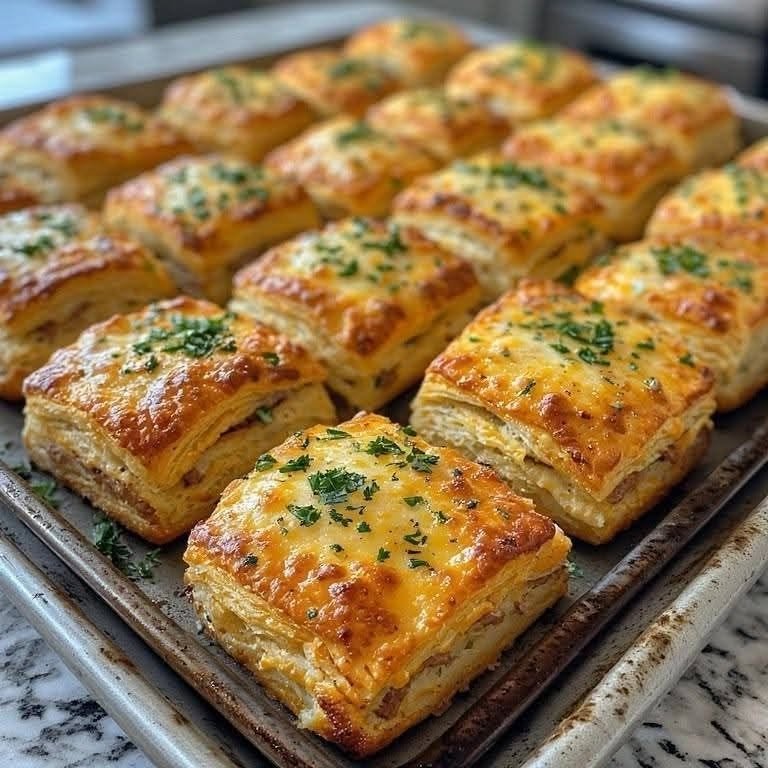
Golden, flaky pastry filled with a rich garlic-and-herb cheese mixture, topped with bubbling cheddar and Parmesan. This recipe is designed to closely recreate the pastries shown in your photo.
Yield: 10–12 pastry squares
Prep time: 25 minutes
Chilling: 20–30 minutes
Bake time: 20–25 minutes
Total time: About 1 hour
Oven: 400°F (200°C)
Ingredients
Pastry
2 sheets puff pastry, thawed but still cold
1 cup (110 g) sharp cheddar cheese, shredded
½ cup (55 g) mozzarella, shredded
¼ cup (25 g) Parmesan, finely grated
2 tbsp (28 g) unsalted butter, softened
2 cloves garlic, finely minced or grated
1 tbsp fresh parsley, finely chopped
1 tsp Italian seasoning
¼ tsp black pepper
¼ tsp salt
Topping
½ cup (55 g) shredded cheddar
1 tbsp (5–7 g) Parmesan
1–2 tbsp chopped fresh parsley
Optional: ¼ tsp garlic powder
Egg wash
1 large egg
1 tbsp milk or water
Optional garlic-butter finish
2 tbsp (28 g) melted butter
1 small garlic clove, grated
1 tbsp fresh parsley, chopped
Small pinch of salt
Instructions
- Thaw the puff pastry
Remove the puff pastry from the freezer according to the package directions.
It should be pliable enough to unfold but still cold.
Don’t let it become warm or soft. Cold pastry gives you better flaky layers.
- Make the cheese filling
Add the following to a bowl:
1 cup cheddar
½ cup mozzarella
¼ cup Parmesan
2 tbsp softened butter
minced garlic
parsley
Italian seasoning
black pepper
salt
Mix thoroughly.
The mixture should be moist enough to hold together but not wet or runny.
If it seems very loose, refrigerate it for 10 minutes.
- Cut the pastry
Lightly flour your work surface.
Place one sheet of puff pastry on the surface.
If needed, gently roll it to approximately ⅛ inch (3 mm) thick.
Cut it into 5–6 rectangles.
Repeat with the second sheet.
You’ll have approximately 10–12 pastry pieces.
- Fill
Place about 1½–2 tablespoons of cheese filling in the center of half of the pastry rectangles.
Leave approximately ½ inch around the edges.
Don’t put the cheese all the way to the edge.
- Seal
Lightly brush the exposed pastry edges with water.
Place another pastry rectangle on top.
Press the edges together firmly with your fingers.
Then use a fork to crimp the edges.
This creates the decorative edge and helps prevent the cheese from escaping.
- Chill the assembled pastries
Place the pastries on a parchment-lined baking sheet.
Refrigerate for 20–30 minutes.
This is an important step.
Cold butter in the pastry creates steam in the oven, which helps separate the layers and produces that flaky texture.
- Apply the egg wash
Whisk together:
1 egg
1 tbsp milk or water
Brush the egg wash over the tops of the pastries.
Try not to let egg wash run heavily down the sides because it can interfere with the pastry layers rising.
- Add the cheese topping
Sprinkle each pastry with:
shredded cheddar
Parmesan
optional garlic powder
Don’t completely bury the pastry in cheese—the pastry should still be able to puff.
- Bake
Preheat the oven to 400°F (200°C).
Bake for 20–25 minutes.
They’re ready when:
the pastry is puffed
the layers are clearly visible
the tops are deep golden brown
the cheese is melted and bubbling
the bottoms are crisp
For especially large pastries, you may need 25–30 minutes.
Optional Garlic-Butter Finish
Combine:
2 tbsp melted butter
1 grated garlic clove
1 tbsp parsley
pinch of salt
Brush a small amount over the hot pastries immediately after removing them from the oven.
Don’t saturate them—the pastry should remain crisp.
Allow the pastries to rest for 5–10 minutes before serving.
Tips for Perfect Pastries
Keep everything cold
Warm puff pastry becomes difficult to work with and won’t rise as well.
Don’t overfill
Too much cheese can cause the seams to burst.
Use freshly shredded cheese
Freshly shredded cheddar and mozzarella generally melt more smoothly than heavily processed pre-shredded cheese.
Seal thoroughly
A fork-crimped edge gives you both a good seal and the classic pastry appearance.
Bake until genuinely golden
Underbaked puff pastry can taste doughy and greasy. A deep golden color is desirable.
Don’t skip the chill
If you have time for only one extra step, chill the assembled pastries before baking.
Allergen & “Nut” Information
These pastries do not traditionally contain tree nuts or peanuts.
However:
Milk: Yes — butter, cheddar, mozzarella and Parmesan.
Egg: Yes — egg wash.
Wheat/gluten: Yes — conventional puff pastry.
Peanuts: Not an intentional ingredient.
Tree nuts: Not an intentional ingredient.
Soy: Depends on the puff pastry and cheese brands.
Sesame: Depends on the packaged puff pastry and ingredient labels.
If you’re preparing these for someone with a serious allergy, check every packaged ingredient, especially puff pastry and pre-shredded cheese, for allergen statements and cross-contact warnings.
Nutrition Information
Because puff pastry and cheese brands vary substantially, these numbers are estimates rather than laboratory nutrition values.
Assuming 12 pastries and the ingredients above:
Nutrient Approx. per pastry
Calories 330–360 kcal
Protein 9–11 g
Total fat 24–27 g
Saturated fat 12–14 g
Carbohydrates 17–21 g
Fiber 1–2 g
Sugars 1–2 g
Sodium 400–550 mg
Cholesterol 45–65 mg
The actual nutrition can change considerably depending on the puff pastry, cheese, butter and amount of topping used.
To reduce calories
Use less cheese topping and make smaller pastries.
To increase protein
Add finely chopped cooked chicken or turkey to the filling.
To reduce sodium
Use unsalted butter and lower-sodium cheeses, and reduce the added salt.
Recipe Q&A
Can I make these without puff pastry?
Yes. You can use refrigerated crescent dough, biscuit dough, or homemade laminated dough, but the texture will be different. Puff pastry gives the closest flaky appearance to the photo.
Can I use only cheddar?
Absolutely. Use about 1½ cups shredded cheddar for the filling and topping combined.
Mozzarella is included mainly for a softer, stretchy melt.
Can I use cream cheese?
Yes. Add approximately 4 oz (115 g) softened cream cheese and reduce the mozzarella slightly. The result will be creamier and less flaky inside.
Can I add chicken?
Yes. Add about ½ cup finely diced cooked chicken to the filling.
Make sure the chicken is completely cooked before adding it.
Can I add bacon?
Yes. Use approximately ½ cup cooked, crumbled bacon. Because bacon and cheese are already salty, reduce or omit the added salt.
Can I add spinach?
Yes. Use about ½ cup cooked, very well-drained chopped spinach.
Remove as much moisture as possible to prevent soggy pastry.
Can I make them vegetarian?
The basic recipe is vegetarian as written, assuming your cheeses and puff pastry are vegetarian-friendly.
Can I make them ahead?
Yes. Assemble them, cover, and refrigerate for several hours before baking.
For best results, apply the egg wash and toppings immediately before baking.
Can I freeze them?
Yes. Assemble the unbaked pastries and freeze them on a tray until solid. Then transfer them to an airtight freezer container.
Bake directly from frozen, adding roughly 5–10 minutes to the baking time.
Should I thaw frozen assembled pastries?
You don’t have to. Baking directly from frozen can actually help maintain the flaky texture.
Watch them closely because oven temperatures vary.
Why did my cheese leak out?
The most common causes are:
Too much filling
Poorly sealed edges
Pastry becoming warm
Cheese placed too close to the edge
Oven temperature being too low
A small amount of cheese leakage is normal and can actually create the browned cheesy edges seen in the photo.
Why didn’t my pastry puff?
The pastry may have become too warm, been rolled too thin, or the oven may not have been hot enough.
Make sure the oven is fully preheated before the pastries go in.
Why is the bottom soggy?
Bake on a parchment-lined metal baking sheet, avoid excessive filling moisture, and make sure the pastries are fully baked before removing them.
You can also place the baking sheet on a lower-middle oven rack.
Can I use garlic powder instead of fresh garlic?
Yes. Substitute approximately ½ teaspoon garlic powder for the two cloves of garlic.
Fresh garlic gives a stronger, more aromatic flavor.
Can I use dried parsley?
Yes, although fresh parsley gives a better appearance and fresher flavor.
Use about 1 teaspoon dried parsley in the filling.
How do I get the beautiful golden color?
Use an egg wash and bake until the tops are deep golden brown.
The combination of egg wash + cheese topping produces the rich color visible in the photo.
How do I make them extra cheesy?
Use:
cheddar in the filling
mozzarella for stretch
Parmesan for savory flavor
additional cheddar on top
For an extremely cheesy version, increase the filling by about 25%, but don’t overstuff the pastries.
How should I store leftovers?
Cool completely, then refrigerate in an airtight container for up to 3–4 days.
For best texture, reheat in an oven or air fryer rather than the microwave.
How do I reheat them?
Oven: 350°F (175°C) for about 8–12 minutes.
Air fryer: 325–350°F (165–175°C) for about 4–7 minutes.
The microwave will heat them quickly but will make the pastry considerably softer.
Can I serve them for breakfast?
Definitely. They’re excellent with eggs, fruit, potatoes, or a simple green salad.
What can I serve with them?
Good pairings include:
scrambled or fried eggs
tomato soup
roasted vegetables
green salad
marinara sauce
garlic-herb dip
creamy tomato soup
Best Cheese Combination
For the closest balance of gooey, savory, browned and stretchy, I’d use:
50% sharp cheddar + 30% mozzarella + 20% Parmesan.
The cheddar provides the strong cheese flavor, mozzarella gives stretch, and Parmesan contributes saltiness and browning.
Final result: crisp, deeply golden flaky layers outside, with a buttery garlic-herb cheese center and a bubbling cheddar-Parmesan crust on top.
Leave a Reply